Measuring Waterfall Throughput: From a Private Network to Mainnet
Disclosure
- This article text was prepared with AI assistance.
- All test data, measurements, and reported metrics were produced from actual test runs without AI-generated data.
- Private network:
1,000,000transactions submitted; peak slot83,333.33 TPS, 100% of the configured ceiling. - Mainnet:
1,000,000transactions submitted;83,333.33 TPSreported by Chainspect for Max TPS (100 blocks), with finality uninterrupted.
This article describes how we load-test Waterfall, the network's behaviour under load, and the independent throughput result reported by Chainspect.
What we measure
A Waterfall slot is produced by many block creators in parallel. In the tested configuration a slot lasts 3 s and has 25 creators; a block is limited to 210,000,000 gas, which is exactly 10,000 plain transfers. The theoretical ceiling is therefore:
25 blocks × 10,000 transfers / 3 s = 83,333 TPS per slot
The question of the test is how close the network gets to that ceiling, how long it holds, and whether consensus and finality stay healthy while it does.
How the test runs
- Generate and submit transaction load to the network (
1,000,000value transfers). - Export block-level results from the RPC node and the explorer.
- Aggregate by slot/timestamp and compute throughput metrics.
Private Network Test 30
Full report: Private Network Test 30.
Setup: 16 nodes plus one RPC node, 163,840 validators, 3 s slots, 25 blocks per slot; OVHcloud b3-32-flex instances (8 vCPU, 32 GB RAM) in one region. The network was launched on 17 September 2026 and ran continuously for about two weeks; the test took place on day 12, on a network that had been producing and finalizing blocks since launch, not on a freshly started one.
Run. The load went into blocks at 16:24:54 UTC. Five slots:
| Slot | Blocks | Transactions |
|---|---|---|
| 1 | 25 | 250,000 |
| 2 | 24 | 240,000 |
| 3 | 25 | 250,000 |
| 4 | 25 | 250,000 |
| 5 | 5 | 50,000 |
The reported window covers five slots (15 s of slot time). Three of the first four slots had all 25 blocks of 10,000 transfers — the configured ceiling of 83,333 TPS.
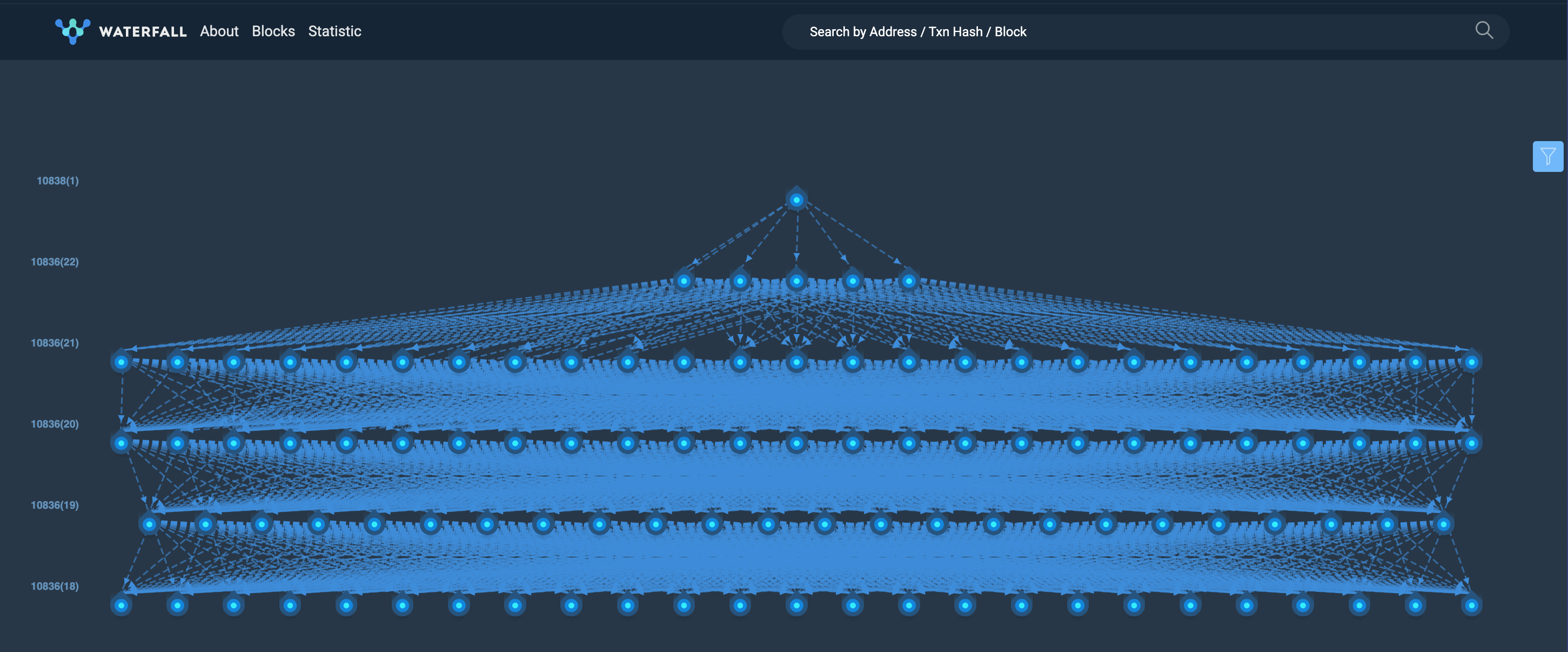 The test window in the explorer's DAG view: five slots of blocks with 10,000 transactions each, followed by the next, empty block.
Consensus under load. Justified and finalized checkpoints moved forward every epoch, with the same checkpoint roots on all 16 nodes. No node client, beacon node or validator restarted. Some nodes briefly lagged while importing the heavy blocks and caught up shortly after the run.
What we learned. In the last two slots, some blocks reference fewer parents than the previous slot had blocks, which points to creators not yet having received all blocks of the previous slot under this load.
Mainnet test
Full report: Mainnet Test 31.
Setup: the live Waterfall mainnet with 148,939 protocol validators recorded by wat_getValidators [23252] — the same 3 s slots, 25 blocks per slot and 210,000,000 gas per block as the private network.
Before the mainnet test, a network upgrade reduced the slot duration from 6 to 3 seconds. Some mainnet nodes had not yet upgraded when the test took place, which may have affected network behaviour under load. All nodes in the private test network were upgraded before testing.
Run. The load went into blocks at 09:14:00 UTC on 2 October 2026:
| Slot | Blocks | Transactions |
|---|---|---|
| 1 | 24 | 240,000 |
| 2 | 21 | 208,167 |
| 3 | 22 | 220,000 |
| 4 | 24 | 240,000 |
| 5 | 23 | 230,000 |
Remaining slots through 372046(19) |
59 | 573,038 |
The first slot contained 240,000 transaction entries in 24 full blocks. The reported window ends at slot 372046(19), matching the last slot visible in the DAG screenshot. It covers 173 blocks, with block timestamps from 09:14:00 to 09:14:33 UTC; later slots are excluded.
Consensus under load. Justified and finalized checkpoints kept moving every epoch; the team's monitored nodes stayed in sync and no client restarted.
Independent measurement: Chainspect
On 3 October 2026, the Waterfall page on Chainspect displayed 83,333 tx/s for Max TPS (100 blocks).
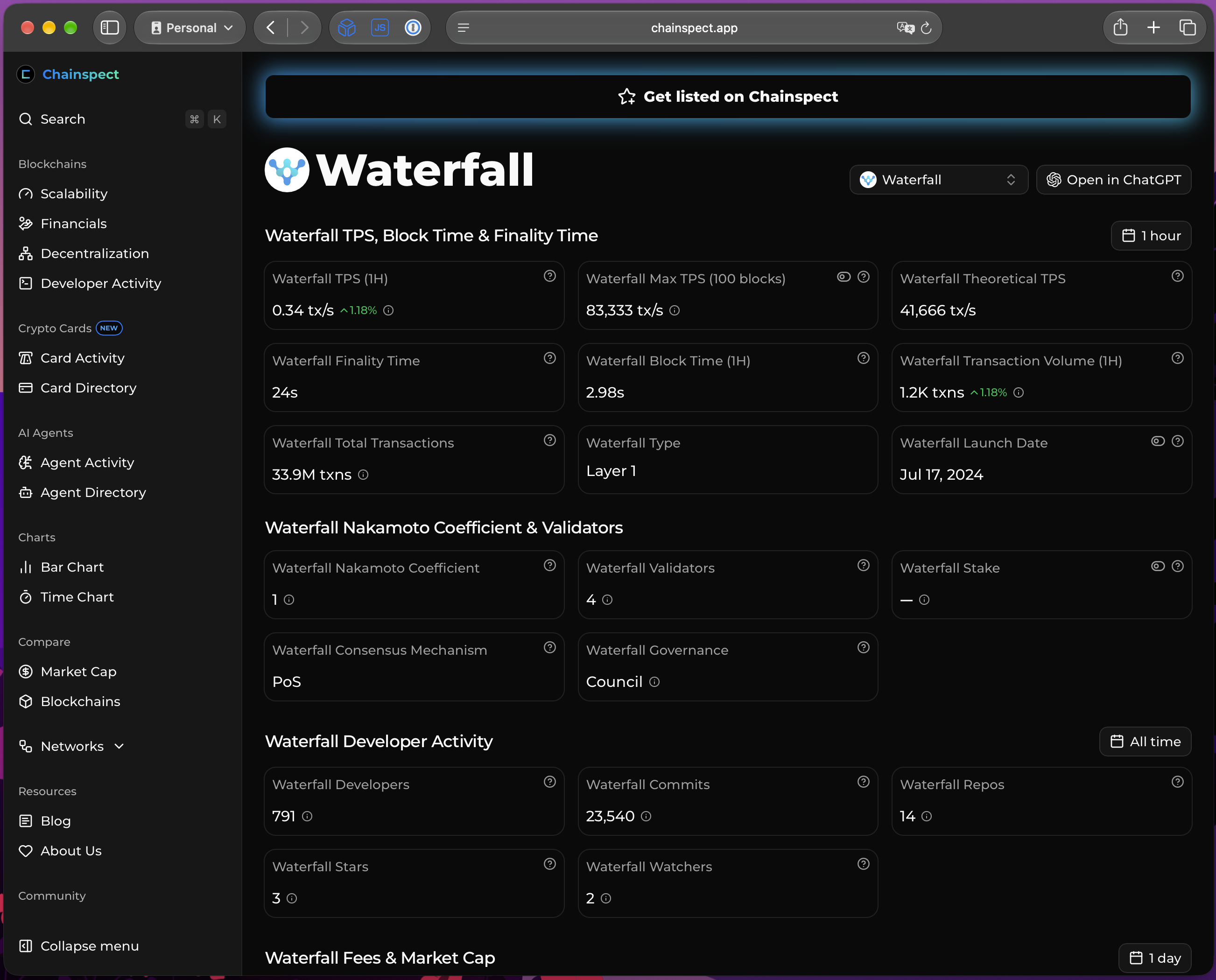 Chainspect overview captured on 3 October 2026. The validator card shows an outdated count; the test-era count of
148,939 protocol validators comes from RPC data. The 1-hour activity and finality values describe the capture period.
The recorded indexer update associated the maximum with block 16511066.
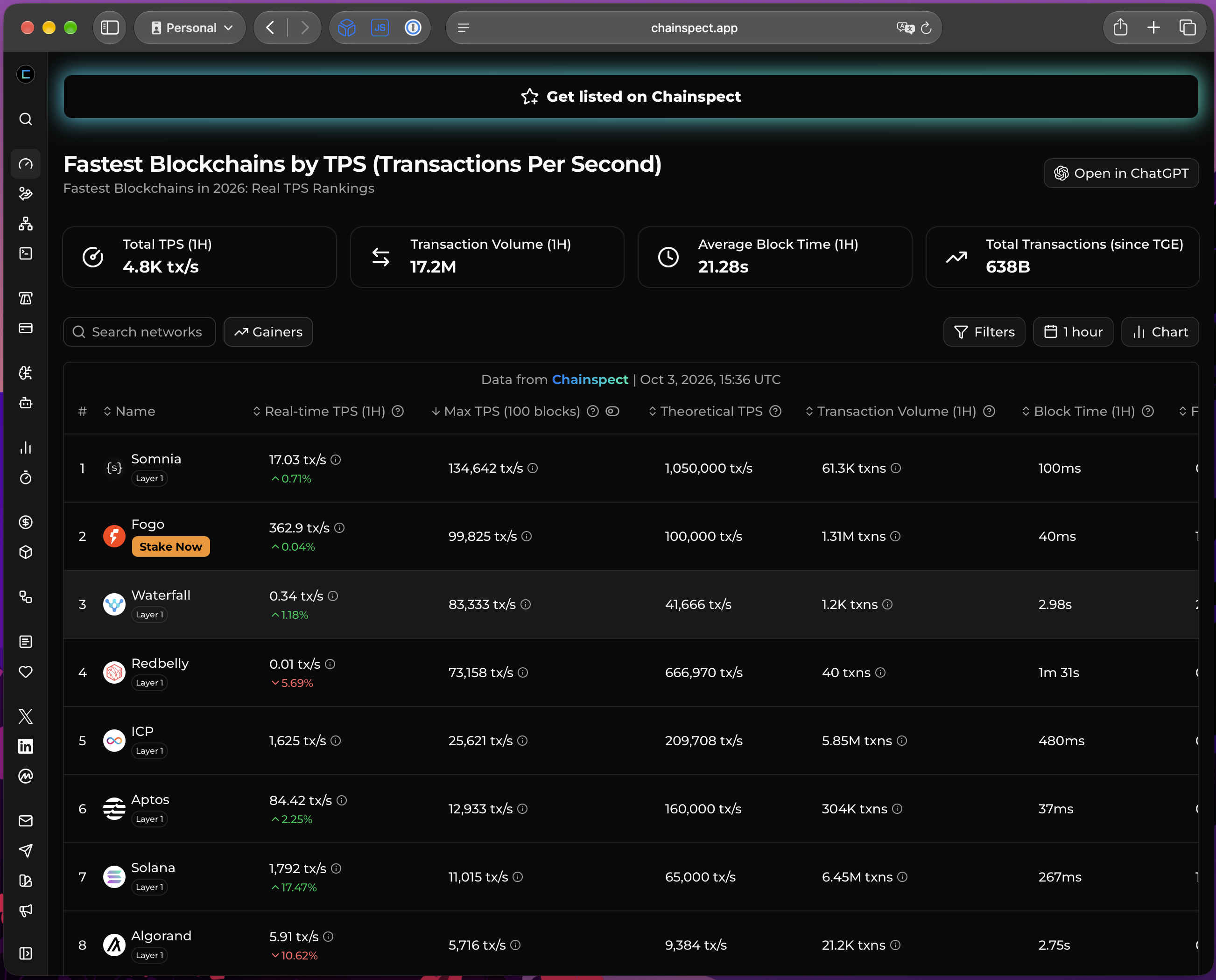
In the captured ranking sorted by Max TPS (100 blocks), with Keeta Testnet excluded, Waterfall was third, behind Somnia (134,642 TPS) and Fogo (99,825 TPS). Including Keeta Testnet placed Waterfall fourth. This is the position in those captured lists on that date.
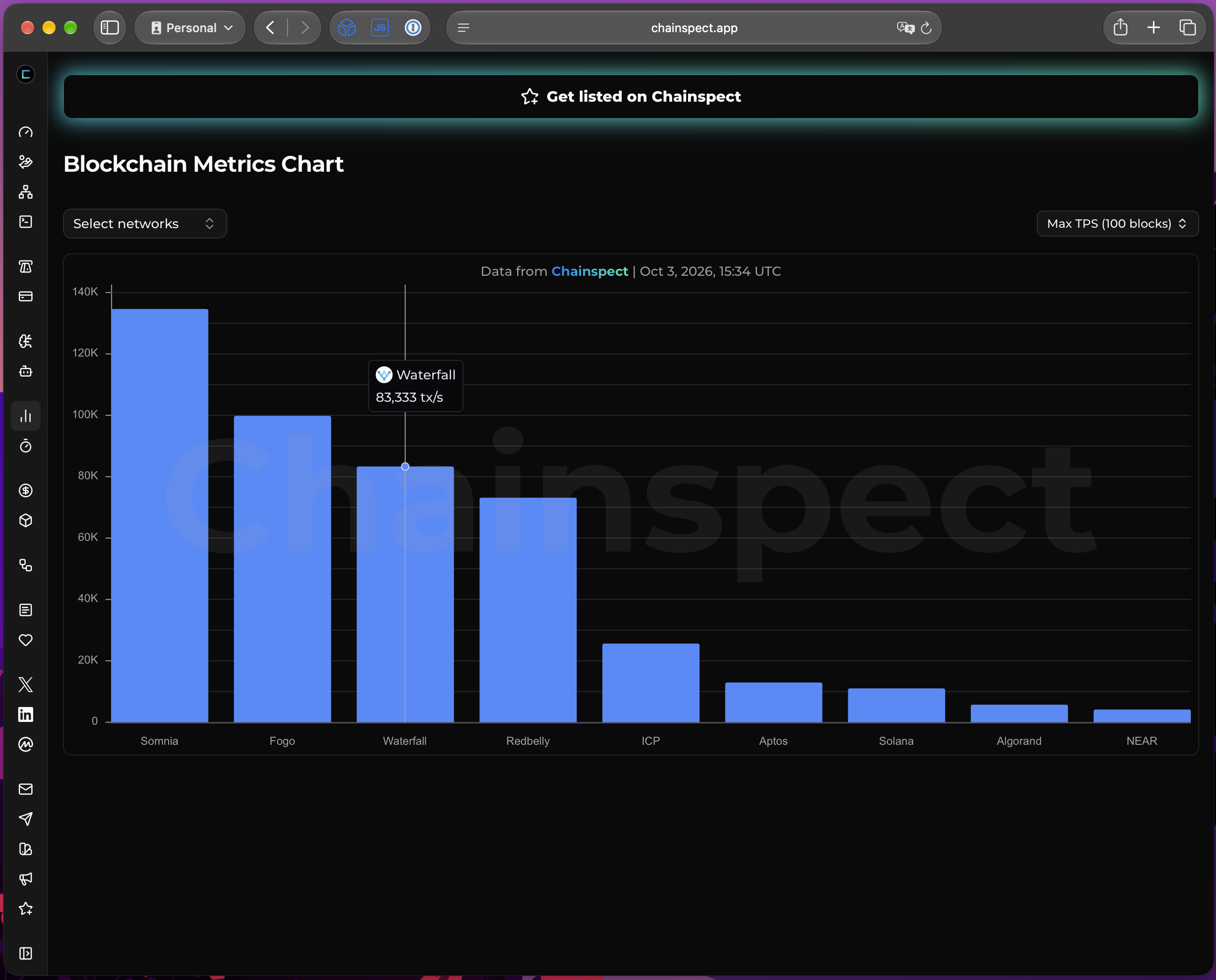 Comparison chart timestamped 3 October 2026, 15:34 UTC; Keeta Testnet excluded.
Captured ranking table — 3 October 2026, 15:36 UTC
Methodology notes
- Test load refers to submitted transactions. Tables show transaction entries per block; see the full reports for the counting convention.
- Protocol validator counts come from the test network records and RPC data. One node can host multiple validators.
- The workload uses plain value transfers of
21,000gas. A full block holds10,000transfers; some mainnet blocks are only partly filled. - The mainnet throughput result is Chainspect's Max TPS (100 blocks), recorded on
3 October 2026. - Time is given in UTC.
Conclusions
The private network reached the configured ceiling in three slots. On mainnet, Chainspect independently reported 83,333.33 TPS for Max TPS (100 blocks) following the test. Justified and finalized checkpoints continued advancing, and the team's nodes remained stable under load.
These tests measure a preloaded burst of plain transfers. The private test used a single cloud region. A network spread across more operators and regions is expected to face longer propagation delays. The results do not establish sustained throughput for arbitrary smart-contract workloads.